
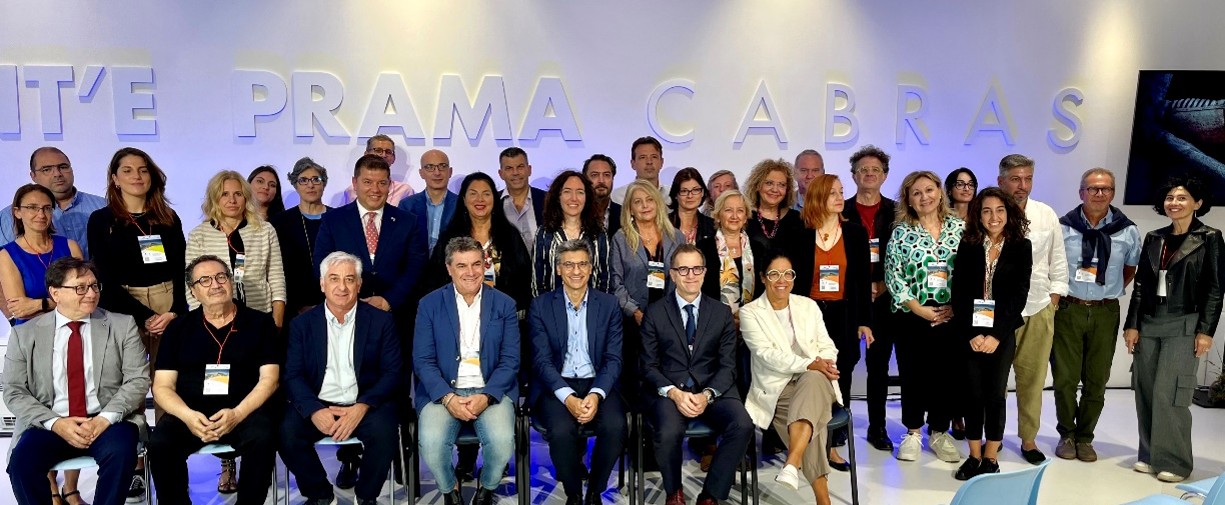
A melting pot of cultures revolving around the same great region—the Mediterranean—came together to network and build a path toward sustainable cultural and tourism development centred on the Phoenician civilization, one of the greatest in history. This is one of the most significant legacies of the XVI Euro-Mediterranean Dialogue, held in Cabras and featuring conferences, exhibitions, meetings, thematic round tables, and guided tours on the occasion of the twentieth anniversary of the Route’s recognition by the Council of Europe.
The association, which celebrated the closing day on October 20th at the Museum of the Giants of Mont’e Prama, successfully combined the local dimension—namely the Sinis area, with its distinctive features and identity—with an international outlook, thanks to the presence of speakers and experts from various European countries and from across the Mediterranean.
Against the backdrop of the Israeli Palestinian crisis, the theme of cultural diplomacy—focusing on what unites rather than divides us—has once again become especially relevant and pressing, particularly in light of the participation of a delegation from Lebanon, which has long been committed to dialogue and exchange for the development of the entire region.
The final day featured the International General Assembly of the Phoenicians’ Route – Cultural Route of the Council of Europe, during which delegates also renewed the association’s governing bodies. More importantly, they approved the new action plan for the next three years, including initiatives in support of coastal communities (Sea Eco museums), new tourism strategies focused on “regenerative tourism” as an evolution of the concepts of sustainability and responsible tourism, and, looking ahead to 2024, the promotion of roots tourism aimed at reconnecting with the communities of the various diasporas resulting from European and Mediterranean migration.
The public meeting of the XVI Euro-Mediterranean Dialogue on the Phoenicians’ Route followed: the celebratory event marking the 20th anniversary of the recognition of the Phoenicians’ Route as a Cultural Route of the Council of Europe (2003–2023), attended by international delegations and representatives from the fifteen countries involved, as well as representatives of other Euro-Mediterranean Cultural Routes.
Also present in Cabras was Stefano Dominioni, Executive Secretary of the Enlarged Partial Agreement on Cultural Routes of the Council of Europe and Director of the European Institute of Cultural Routes.
The rich three-day program was therefore a major event in the heart of the Sinis region, bringing together populations and cultures from three continents, united by a common mission of dialogue and cultural, economic, and social development.
The event, hosted by the Mont’e Prama Foundation—whose members include the Italian Ministry of Culture, the Autonomous Region of Sardinia, and the Municipality of Cabras—received the High Patronage of the European Parliament and the Italian Ministries of Culture, Tourism, Foreign Affairs, and International Cooperation.
<img class=”alignnone wp-image-987499232 size-large” src=”https://fenici.net/wp-content/uploads/2023/10/Dialogue-on-the-Phoenicians-Route-712×1024.jpg” alt=”” width=”712″ height=”1024″ />


0 Comments